in solidarity we… | 2018.01.31

It Can’t Happen Here by Sinclair Lewis | Review
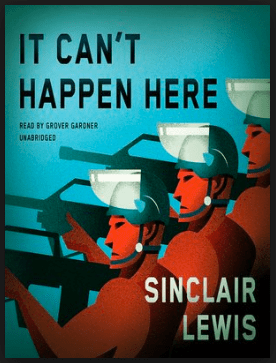
Lewis, Sinclair_It Can't Happen Here

Publishing: Ashland : Blackstone Audio, Inc., and Buck 50 Productions, LLC, 2008 (Originally published 1935)

Genre: Fiction

Pages: 383 | Audio Length: 14 hours 17 minutes

Formats: Paperback, eBook, Audiobook

Source: MCL

There are some books that give us hope by the sheer voice of their solidarity. They are the solace we need to survive our darkest hours. I found Sinclair’s It Can’t Happen Here to be such a book. According to a January 2017 article from The New York Times, “within a week of the 2016 election, the book was reportedly sold out on Amazon.com.” Listening to the audiobook version of this 1935 dystopian fantasy (the unabridged reading by Grover Gardner is recommended) while making dinner one evening a full year into our 45th president’s administration, my partner paused in the midst of his garlic chopping duties to ask if we were listening to an actual news report. He had to shortly thereafter leave the kitchen, despair weighing his head down to his chest.

If we could already see the writing on the wall, then why did this book hold for apparently so many readers such an obsessive infatuation? The lyrics of my lady and yours, Ani Di Franco, rang in my ears while exploring this book, with the only relief from the horrors of this cautionary tale seeming to be a sought-after great escape to our inarguably more reasonable sister to the north. The appeal of Lewis’s book, in this reader’s humble opinion, is its exemplification that even the most liberally-minded among us may not immediately recognize a fascist takeover of our beloved land of the free even when it stares straight into our Twitter-haggard eyes. (Although I’m pretty sure the true activists of our society haven’t been deceived yet.) All in all, Lewis’s novel, wonderfully written as well as prophetically contrived, is a comfort if in nothing else but to confirm you’re not going crazy if you find yourself constantly cringing at our current national news.
the freedom to read | 2018.04.11

Catch-22 by Joseph Heller | Review

Heller, Joseph_Catch-22

 Publishing: New York : HarperAudio, 2007 (Originally published 1961)

 Genres: Satire

 Pages: 524 | Audio Length: 19 1/2 hours

 Formats: Paperback, eBook, Audiobook

 Source: MCL

What intrigued me most, as deeply nerdy as it may be, about this book was its narrative style. I have a prejudice perhaps that is always asking why modern (by which I mean current; not modern in the literary sense that’s taught in your typical college literature courses) writers don’t play with things like nonlinear narrative style anymore. But maybe I need to update my reading list (probably this is truer than I’m ready to admit).

And if you’re going to read this one but feel pressed for time, I’d highly recommend checking your local library for the unabridged audiobook version performed by Jay O. Sanders. What a performance, Mr. Sanders! Truly. Well done!

Littered with colorful characters such as the overly logical and ever-frustrated John Yossarian, the slippery entrepreneur Milo Minderbinder, the horse chestnut-cheeks-stuffed Orr (that name, like many of the others, is no mistake), and the ever-indecisive Major — De Coverley (artfully pronounced in turns as Major Aha, Mhm, and Haha De Coverley for the audio version), the book fits and starts its way through the nagging questions of why war and why the societal ever-grasping for prescribed success. Using each character in turn, Heller presents the book’s main premise of circular reasoning to trot out the narrative events. George R. R. Martin’s well-popularized Game Of Throne and James S. A. Corey’s The Expanse series are the most readily available examples I can think of that also utilise the third person limited perspective in our modern (a.k.a. current) literature realm (if you have other shouts to give…well, the LEAVE A REPLY feature is below, so let’s trade literary passions, friend). But I still think Heller’s use of this device would be hard put to find its true competitor. And this because, again, it informs his book’s theme of how political and economic goals are inescapably perspective-based.

Before reading Heller’s masterpiece, I always wondered what the phrase Catch-22 had been created to describe. Turns out, it’s anything you can contrive! Spin, spin, spin is the name of the game in the book’s maybe-not-so alternate universe. So, why do high school literature teachers force this deeply intellectual and sometimes confusing read on their students? Probably for the same reason my obsessively conservative parents pulled me out of my first AP Literature class when they saw this title (among Flowers for Algernon, 1984, and Slaughterhouse Five) on the reading list. Because it masterfully illustrates the subtle truths of our postmodernist, curious, and at times deeply troubling culture as a species.

The book has a very Zen pull as it nears its conclusion, almost as if Heller knew the reader would need time to exhale. A kind of urging to escape from the craziness that is our overly-sophisticated society, where simply surviving becomes a constant struggle against regulators and endless forms to be filled out (my day-job as an insurance analyst makes this resonate all too close to home). Is there any escape from the machine of systems and cultural expectations? Heller leaves room for inspiring conjecture. Need we say more?


sentient prejudice | 2018.05.03

Autonomous by Annalee Newitz | Review

Newitz, Annalee_Autonomous

 Publisher: New York : Tor, (2017)

 Genres: Science Fiction

 Pages: 301

 Formats: Paperback, eBook, Audiobook

 Source: MCL

“What characteristics would you use to define sentience?” I annoyingly asked at a local reading of this book’s introduction. Word of advice: don’t ask the author the question they write their book to answer. If the premise of their creation could be solved in a Q&A session, why write the goddamn book in the first place?

Fiction is meant to link what we otherwise couldn’t explain without the freedom of descriptive experiences. Isn’t that what art is for, especially in its most elusively imaginative forms such as sci-fi and fantasy? The philosophical among us may be able to use maieutics to effectively get our points across to our friends, but, as my partner often laments, it can all get too theoretical to actually discuss after a point. And so enters the illustrative power of narrative.

In her debut novel, Newitz balances theory with contemplative imagination, weaving not just another cautionary tale about the dangers of humans playing god. Her characters, both human and android, have a depth that can’t be ignored. While the dialog may not sweep you off your feet, and while she seems to grapple like most of us writers with how to show instead of overtly tell the foundational elements of her world-building throughout the story, the skill with which she captures the inner workings of her android characters is undeniable.

Does this version of events have anything new to offer within our overstuffed literature on the topic of what constitutes an autonomous existence? I’d say absolutely. Because Newitz isn’t only exposing the multitude of possible consequences of creating steel-servants in humanity’s own image. The book also boldly broaches topics of slavery, both for the androids in her story, as well as for their human equivalents. In Newitz’s sci-fi world, the characters find themselves enslaving their own children based on a moralistic premise of equality in which they are left asking whether they can justify hoping for sentience within beings they’ve created while still being unwilling to set their creations free to choose their own adventures. Newitz not only revisits the themes of indentured servitude explored in both the original and the revamped West World stories (among many other such tales), but she pushes the envelope back across the table to demand the reader consider a world where the android versus human allegiances are becoming more and more blurred.

All in all, I was surprised to discover this isn’t another story exemplifying the us-versus-them saga (as much as our tiny rat brains might long for whole buckets of these). Instead Newitz explores the landscape of a world of merging consciousnesses. And in our current world where we have to constantly beat prejudice over the head as it tirelessly threatens to again rule the day (and in many ways, sadly, already has), such an exploration is so so needed.


fantastical | 2015.10.02

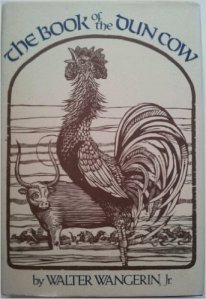
The Book of the Dun Cow by Walter Wangerin Jr | Review

 Book Jacket_Wangerin, Walter Jr.The Book of the Dun Cow


Published by: Harper & Row, Publishers, Inc.; 1st  edition (1978)
Genre: Fantasy
Pages: 241
Format: Hardcover
Source: MCL

At first glance, this is another classic tale of good versus evil. However, Wangerin seems hesitant to draw his characters, even those charged with rising to literally save the day from an all-consuming darkness, with fixed lines of moralistic certainty. As a result, a story that flows in the sing-song prose of a brilliantly written children’s book is simultaneously able to plum the depths of the individual psyche (it seems awkward to say “human psyche” as the book is entirely populated with animals).


The Princess Bride: S. Morgenstern’s Classic Tale of True Love and High Adventure by William Goldman | Review


Published by: Ballantine Books; 1st  edition (1998)
Genres: Fiction
Pages: 399
Format: Hardcover
Source: MCL

Let’s talk about framing devices. Goldman’s high-adventure, action-packed novel begins by recounting his grandfather’s reading of S. Morgenstern’s epic tale The Princess Bride, then meanders off to explain Goldman’s own epic journey to locate the original manuscripts of the fictional author, meanwhile giving the reader “revised” snippets of that same “original” masterpiece.

This book is a wonderfully hilarious portrayal of the thrilling torture involved in trying to redefine the genre of legends. While the book is usually marketed to teen readers, it is also completely appropriate for adults looking to chuckle a weekend away on the waves of irony.


women in history | 2015.08.09

Minor Characters by Joyce Johnson | Review

 Book Jacket_Johnson, Joyce.Minor Character


Published by: Houghton Mifflin; 1st  edition (1983)
Genre: Memoir
Pages: 262
Format: Hardcover
Source: MCL

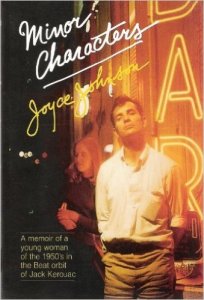
While the cover thrusts the perfectly chiseled jaw of Jack Kerouac toward the impending reader, the guts of this masterpiece focus on the life of a young woman growing up in the thrilling yet tumultuous 1950’s of a beatnik riddled New York City. The author recounts tales of a world on the brink of changing forever, where her inquisitive spirit allows her to be drawn into the heart of what became one of the most influential cultural cyclones of our time.

This is not only a look behind the man who compulsively wrote novels on his elusively famous scroll for three weeks without taking a breath. This is a literary megaphone for the voices and experiences of the other half of the population that would’ve otherwise been forgotten.


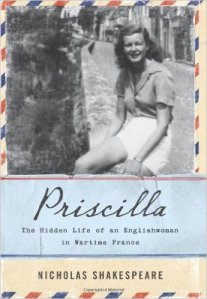
Priscilla: the Hidden Life of an Englishwoman in Wartime France by Nicholas Shakespeare | Review


Publishing: Harper (2014)
Genres: Biographical Memoir
Pages: 423
Format: eBook and Hardcover
Source: MCL

If you’ve ever wondered what mysteries can be solved within the dusty archival vaults of French and English parish houses, military museums, government buildings, etc., along with what treasures of family history might be contained in long forgotten attics, then this is the book for you.

If you’ve ever longed for an up close and personal look at the blackmarket underbelly of an Axis-occupied Paris during World War II, then this would also be a good choice for your summer reading list.

Beyond the above-mentioned interests within the book, and perhaps even standing on their support, Shakespeare pulls his readers into his own quest to understand the world through his aunt’s eyes. His writing makes it clear that Priscilla’s experiences were not only shaped by the terrors of occupied France, but also by a culture where a young woman’s best weapon of defense was her charms.


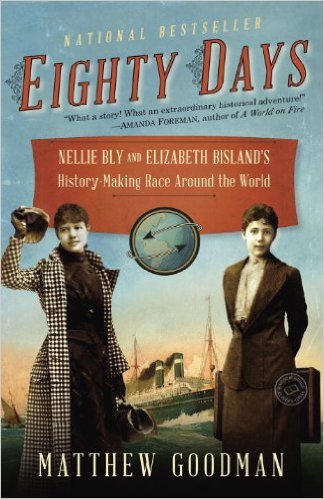
Eighty Days by Matthew Goodman | Review


Published by: Ballantine Books (2013)
Genres: Biography / History / Travel
Pages: 496
Format: eBook and Hardcover
Source: MCL

Goodman takes his readers on a true adventure into the heart of the late 1800’s, describing the struggles and successes of two unlikely opponents in their race around the world to beat the fantastical record of the then bestselling author, Jules Verne.

The book might be one of the most readable historical accounts ever to grace the pages of the written medium. No side-note is left dangling, as Goodman carefully interweaves his detailed descriptions of a world now over a hundred years past into his biographical tracing of these two young female journalists. Readers have the chance to learn about the intricacies, and sometimes stench and filth, of late nineteenth century travel, meet the famous French science fiction author who inspired Nellie Bly and Elizabeth Bisland’s publishers to send them both off in opposite directions around the globe, and explore the sights and smells of each new and distant land these women traversed.