the evolution of speculative fiction | 2018.09.18

Lost Horizon by James Hilton | Review

hilton, james_lost horizon

Publication: Macmillan 1933

Genre: Utopian Fiction, Fantasy Fiction, Adventure Fiction

Pages: 241

Formats: Paperback, eBook, Hardcover

Source: MCL

Recently, I’ve found myself amazed at the development over the last century of the explorer’s journey within speculative fiction. Before the well-known theme of spaceships that ran the gauntlet of the outer reaches of this or that solar system or of adventures from galaxies far, far away, the idea of exploring the unknown was predicated on peering down avenues much closer to home.

Originally published in 1933, James Hilton’s Lost Horizon takes the reader on an exploratory journey that has the familiar hint of Jules Verne. I was elated to find out this story’s chosen destination of “the unknown,” in which its characters grapple with philosophies of life, economics, religion, love, death, and eternity (idealized themes right in line with the hopes and dreams of most science fiction readers these days), is none other than the now wonderful and yet ever mysterious paradise of Shangri-La. For Shangri-La (as I’m sure you remember) is not nestled on some distant planet with creative creatures of mixed origins or the product of some biotechnical accident resulting from humans again overreaching in their efforts to colonize their ever-expanding generations. Nope, folks. Shangri-La is simply a ridiculously peaceful and prosperous community hidden somewhere deep within the folds of mountainous Tibet.

Usually, when approaching these types of books — meaning the earlier science fiction pieces — I brace myself for a ride down memory lane in the cultural sense. Male characters more often than not play the role of the egotistical macho, ready to blast any and everything that dares come near their latest and greatest experiment or discovery. I’m thinking particularly of H. G. Wells’s The Invisible Man, as well as She: A History of Adventure by H. Rider Haggard, which perhaps are unfair generalizations, given the historical events that separate these works from Hilton’s Lost Horizon. For example, I don’t think the jarring impact of the first World War on humanity’s collective society can be overlooked, so that to compare the fictional endeavors of Haggard and Wells (who were writing their adventure stories in the very late 1800s) with Hilton’s tale of a recent World War I veteran discovering the tranquility of the elusive Shangri-La paradise . . . well, it’s not a balanced scale, that one.

The only advantage I can see to such a comparison, however, is that it is exactly in the shadow of World War I that Hilton’s character-driven plot is able to race itself toward the safety of the Shangri-La haven. For an offering of paradise only gains in luster when the world’s normalcy has already descended into recent horrific chaos.

The descriptions of the book’s main character, the war-sobered Conway, show this effect in Hilton’s projection of the state of societal consciousness at the time he was writing this story. As each scene progresses, Conway seems to become more and more the hero’s hero. This is a character who can artfully, and with demure measure, navigate through the unknown at every turn. The reader sees Conway again and again, through strong and quiet leadership (you know you’re developing a crush on this fictionalized darling of a personality, too . . . I’ll reserve judgement if you will), helping to keep his fellow travelers from devolving into puddles of fear or into acts of violence when the facts are slim among them.

What more could be hoped for in a fantastical journey such as this than a resting place in which the characters and readers are invited to hide away from the meanness of reality? This book certainly gives a new spin to goals of escapism, bringing the ideals of the unknown and the other-worldly to our very backyard in a way.

exquisitely orchestrated prose | 2018.11.04

Anil’s Ghost by Michael Ondaatje | Review

Ondaatje, Michael_Anil's Ghost

Publication: New York : Vintage International, 2001, ©2000

Genre: Psychological Fiction, Mystery Fiction, Historical Fiction

Pages: 311 | Audio Length: 7 hours, 53 minutes

Formats: Paperback, Audiobook, eBook, Hardcover

Source: MCL

Some books should be read for the author’s mastery of plot, while others win their stripes of lasting worth due to how well they play in the realm of language. I find myself usually attracted to the latter, although I can also understand the appeal of the former. But to me, reading a piece of exquisitely orchestrated prose can be like letting the music of Rachmaninoff, Mendelssohn, or Tchaikovsky (just to name a few) wash over the soul. And this is what I’m looking for in the act of reading most days. Call it a preoccupation, maybe.

While listening to the audiobook version of Ondaatje’s novel, I bookmarked a dozen or so quotes not because I wanted reminders of what actions this or that character was engaged in, or of the major building blocks leading to the story’s climax. Instead, I was collecting the sparkling gems of Ondaatje’s wordsmith talents. Some of my favourites are listed below for your reading enjoyment.

As I was re-listening to these particular quotes for this review, I also noticed that a good majority of them carry the driving force behind what I took to be the book’s message. Namely, that history is a cultural creation. As much as we’d like to say we can objectively report on historical discoveries or that history is a collection of revelations about past events, as long as humanity has greed and drives for immediate survival (evolution just doing its job, I suppose), history will always be subject to these more biased goals.

In Anil’s Ghost, the reader wanders through the multiple, and often disparate, perspectives of its characters as they try each one to hold the sands of history in some semblance of a meaningful shape against the flood waters of time. I’m also a huge fan of somewhat ambiguous endings (which I mention not to give anything away, but to give you a fair heads-up if you’re not into that sort of thing), so I found a lot to admire in this novel.

Favorite lines of the most beautiful and thought-provoking prose from Anil’s Ghost to brighten your holiday season . . .

“Information was made public with diversions and subtexts, as if the truth would not be of interest when given directly, without waltzing backwards.”

“She used to believe that meaning allowed a person a door to escape grief and fear, but she saw that those who were slammed and stained by violence lost the power of language and logic. It was the way to abandon emotion–a last protection for the self.”

“Even reading, she’d gotten entangled sleepily in the arms of paragraphs that wouldn’t let her go.”

“Farther away there were wars of terror, the gunmen in love with the sound of their shells, for the main purpose of war had become war.”

“Most of the time in our world, truth is just opinion.”

“Even if you are a monk [. . .] passion or slaughter will meet you someday. For you cannot survive as a monk if society does not exist. You renounce society, but to do so you must first be a part of it and learn your decision from it. This is the paradox of retreat.”

“He supposed he had always trusted her, in spite of her fury and rejection of the world. He weaved into her presence his conversations about wars and medieval slokas and Pali texts and language, and he spoke about how history faded too, as much as battle did, and how it could exist only with remembrance–for even slokas on papyrus and bound ola leaves would be eaten by moths and silverfish, dissolved by rainstorms–how only stone and rock could hold one person’s losses and another’s beauty forever.”

“A good archaeologist can read a bucket of soil as if it were a complex historical novel.”

“When we are young, he thought, the first necessary rule is to stop invasions of ourselves. We know this as children. There is always that murmuring conviction of family, like the sea around an island. So youth hides in the shape of something as lean as a spear or something as antisocial as a bark. And we become therefore more comfortable and intimate with strangers.”

“He’s going home. So the war, to all purposes, is over. That’s enough reality for the West. It’s probably the history of the last two-hundred years of western political writing: Go home, write a book, hit the circuit.”

“And now with human sight he was seeing all the fibres of natural history around him. He could witness the smallest approach of a bird, every flick of its wing, or a hundred-mile storm coming down off the mountains near Gonagola and skirting to the planes. He could feel each current of wind, every lattice-like green shadow created by cloud.”

Please take a bow, Ondaatje; for such beauty is hard to find.

books on writing | 2018.07.24

Steering the Craft: A Twenty-First Century Guide to Sailing the Sea of Story by Ursula K. Le Guin | Review
Le Guin, Ursula K_Steering the Craft

Publication: Boston ; New York : Mariner Books, Houghton Mifflin Harcourt, 2015

Genre: Authorship, Narrative Writing

Pages: 141

Formats: Paperback, eBook

Source: MCL

Let’s talk about writing exercises. Le Guin packs this modest-sized book full of lunges, squats, and sometimes gut-wrenching sit-ups all the way through. As a result, you’ll want your favourite writing tools nearby while diving into this one. But it’s not exercising because it’s the fashionable thing to do or because you don’t have any of your own writing topics to play with.

Le Guin states in the book’s opening lines that she composed this “handbook for storytellers — writers of narrative prose.” She further explains in her introduction that the book is for those who know how to write at least competently, and perhaps even rather well, but who also want to hone their talents around the more technical waters that can often throw even a great writer somewhat off course. When we write, we want to be heard, and to be heard is to be understood. Writing is our medium toward spiritual (the term being used generally, rather than with religious specificity) connection. To connect with another sentient being is to strive towards clarity, and not even clarity in the puritanical sense, but simply as a meeting of all the elusive mind-and-emotive-stuff we couldn’t otherwise hope to express.

It’s no pun that Le Guin uses the word craft in her book’s title, because writing is just that. Because just like the products of a master musician or painter, we’d expect the finished pièce de résistance to be the result of years of practice. And who knows? Maybe you’ll get a few usable story-gems out of the writing exercises she gives at the end of each chapter. But please don’t be surprised if many revisions prove needed after each painstaking draft. As mentioned, this is a book to help aspiring writers stretch and practice the artistry that is prose writing. Failing at any endeavor is part of the comparable success story in the end.

If you’re truly going to approach your writing with the concentration of a master, Steering the Craft is a wizard-of-word’s spell book detailing the “practice in control” of bending “the pleasure of writing, of playing the real, great word games” toward usable production. Understanding how to use point of view, verb tenses, short and terse versus long and wandering sentences, as well as the benefits of extricating all those pesky adjectives is how the game is played. (Yes, I’m wringing my hands that “pesky” snuck into that last sentence.) This book provides a sandbox for aspiring writers to root around safely, the only ramifications being to gain a more objective view of their world-building efforts.

Le Guin left such a legacy of word-spun anthro-fiction in her much-missed wake for many of us, and we still have much to learn from her generous advice on the art form she knew best.

Just a quick note: I love that the original version of this book, published in 1998, had the subtitle of “Exercises and Discussions on Story Writing for the Lone Mariner and the Mutinous Crew.” Lots to pull out of that one.


On Writing: A Memoir of the Craft by Stephen King | Review
King, Stephen_On Writing

Publication: New York: Scribner, 2000 | Republished in 2010, 10th Anniversary Edition

Genre: Authorship, Narrative Writing, Memoir

Pages: 288

Formats: Paperback, eBook, Audiobook

Source: MCL

I can’t spout enough praise for this one. King gives not only the most humorous advice about the tireless (and more often exhausting) work each writer puts him or herself through, he also offers a memoiristic curriculum vitae to inspire (or perhaps frighten) other writer-wannabes. After the first section of his book opens the blinds of his youth, filled with farting babysitters and countless rejection letters that he pins to his teenage bedroom wall with pride, King gets down to the business of explaining the business of writing.

While we may all want to skip straight to the last section of the book, which details his surviving a van that misplaced its heaving mass into his person while he was walking on the roadside in 2000 (no, the experience wasn’t his inspiration for Misery, which he actually wrote back in 1987, closer to the beginning of his now well-publicized career), the bits of the book I found most inspiring were those focused on his honest assessment of what being a writer takes in the long run.

The surprising answer to this enduring question we who are just beginning the writer’s journey can’t seem to get out of our heads is that the secret to becoming a writer is, quite simply, to write.

King is maybe somewhat harsh in his estimation that bad writers will never improve, and that great writers are born and not made, yet he seems to have a fondness for helping competent writers blossom into good writers. So, there’s hope! Maybe. But who is ever going to tell a bad writer that they’re prose stinks? I’ve never had a composition teacher dare utter such a judgement, but maybe that’s just due to our overly sensitive and politically-steroided culture. I’ve had writing teachers beg me to be on the school newspaper staff or to take up positions as a writing mentor, but the former scared the shit out of me because talking face-to-face with strangers sounds like torture, although I endured with some ecstasy the latter for a couple years in college.

What’s the line between bad and competency when we’re talking about writers? Incompetent writing (to me this equates to bad writing, and maybe King would agree) seems to imply you just don’t understand how to effectively expose your thoughts to an absentee audience, grammar eludes you, and organization is certainly not your forte; but mostly the first of these three. As if you need the crutch of hand gestures and facial expressions to help your actual words get your point across the chasm of understanding. Writing doesn’t allow for visual crutches, as we know all too well from the magical chaos that can destroy relationships and even governments in our world of text messages, email, and Twitter (America has a prime example of this last one at the moment, and if that statement baffles you, well god bless ya for having successfully hidden your head in the sand for the last 24 months). A good writer, according to what I’ve gleaned from King’s book, seems to be someone who is both competent at the composition of written communication and an artistic weaver of tales.

King’s book deals exclusively with writing fiction, but if we’re going to expand his assessment of writing skills to formats such as essays, memoirs, and historical investigative journalism, then I’d say the story weaving criteria still holds true. An essay is a story that follows the meandering yet formulaic thoughts of the writer, thinking specifically of Virginia Wolf’s expanded book-sized essay A Room of One’s Own or Ursula K. Le Guin’s collection Words Are My Matter. As far as historical investigative journalism goes, while The Lost City of Z made for an okay movie version of the historical events it recounted, I’d argue for skipping the televised rendition and just plunging straight into the pages to consume the (here it is again) story just as it was originally laid out by the book’s author. And then we have memoirs like Augusten Burroughs’s Running With Scissors and Kate Chirstensen’s Blue Plate Special, which are themed glimpses into the writers’ lives where the chorus of events are carefully orchestrated until the scenes virtually sing in the readers’ minds.

King also spends time waxing philosophical in his advice to ambitious writers to also read read read. How can you know what’s good, or bad, if you’re locked in a vacuum? Maybe you too wanna write a memoir about all the crazy terrifying things you’ve faced in your short life (even if you’re 107, it’s still relatively short in the grand scheme of our universe’s history, mind you). The best place to start is in front of the autobiography section of your local library or bookstore, baby. As Jo Walton has pointed out, “We all remake our genre every time we write it. But we’re building on what’s gone before.” (https://www.tor.com/2018/01/24/bright-the-hawks-flight-in-the-empty-sky-ursula-k-le-guin/#more-331580) Even the greats of the writing world had influences. And, as a result, even the most individualistic writer’s voice is the product of a literary stew.

The takeaways from King’s book on writing? Write and read like your life depends on it. Guard time for both as you would a scrap of driftwood in a storm-torn sea.

A friendly note to the reader who prefers listening: The audiobook for King’s book does not include the postscript that gives a visual example of what should happen to a first draft after it’s rendered subject to the writer’s critical pen of edits and, hopefully, improvements. Just thought you should know. Nor does it include the two additional postscripts (the second was tacked on in the 2010 republication edition) listing what King was reading while writing On Writing. Just a friendly heads-up. If you’re serious about your writing, get the print version and keep it handy next time you’re sweating over that manuscript that’s been kicking your ass.

Note: Yes, I know some of the words above are made-up. Agatha asks that you kindly engage your sense of humor and imagination. It’s more fun that way.

out from under Jane Austen’s skirts | 2018.07.11

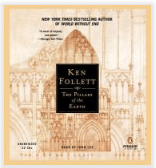
The Pillars of the Earth by Ken Follett | Review

Follett, Ken_The Pillars of the Earth

Publication: MacMillan 1989

Genre: Historical Fiction

Pages: 973 | Audio Length: 40 hours, 58 minutes

Formats: Paperback, Audiobook, eBook, Hardcover

Source: MCL

Having a well-placed sex scene in any book can be absolutely great, don’t get me wrong. Yet Follett’s repeated use of steamy rollicks around misty forest floors mixed in with gruesome rape scenes seem to teeter on the edge of gratuitous descriptions of both violence and soft-porn levels of intimacy. I guess that’s life, isn’t it? (Rape should never be in that category, mind you.) George R. R. Martin uses explicit sex descriptions like this also, along with many other authors, so I guess maybe it’s time I pulled my head out from under Jane Austen’s skirts of propriety and got with the program (terrible, terrible metaphor, I know).

Honestly though, I found this book has so much more than heart-felt and heart-wrenching sex scenes (albeit all of them straight as could possibly be because, of course, non-binary sex wasn’t a thing until June 26, 2015…oh, oh dear!) to offer its readers. The crux of this epic really seems to be about overcoming impossible odds and maintaining some shred of integrity in the shadow of the ever-reaching arm of greed-driven deception and malice.

I’d like to give Follett a huge round of applause for the power and respect he manages to provide his female characters in this book. The women are portrayed not only as strong-willed (a quality when given to any characters other than heterosexual males usually becomes a vehicle for the shrew-stigma to take full charge), but also as intelligent, brave, and often leaders of events that end up advancing the welfare of themselves and their communities. He allows (and takes great measures to encourage) the women in his book to rise above the stereotypes that the more traditional masculine characters try to impose. After a particularly brutal rape, for example, Follett doesn’t have Aliena’s character stab her rapist to death. Instead, he allows the narrative to endow Aliena with the fortitude and economic savvy to pinch her adversary’s earldom out of the market completely, leaving him the destitute fool the reader knew him to be all along.

And the plot structure! This piece is truly an epic bit of storytelling, which Follett pulls off beautifully by knowing when to build his readers’ expectations around each of his multiple main characters, when to push a character toward action to move the story to the next big stake or goal-oriented adventure. Follett also seems to understand the value of making his readers wait for the bigger and better payoffs at the end . . . and that’s all the spoilers I’m going to allow myself regarding that topic. After finishing this one over the summer, I think I finally understand how the book has developed such a devoted cult following.

the art of relatability | 2018.06.26

Blue Plate Special: An Autobiography of My Appetites by Kate Christensen | Review

Publication: New York : Doubleday, [2013]

Genre: Memoir

Pages: 353

Formats: Paperback, Audiobook, eBook, Hardcover

Source: MCL

I’ve been thinking a lot about the attraction of the memoir. This year’s Wordstock (rebranded as the Portland Book Festival) a couple weekends ago gave testimony again to our culture’s currently heightened obsession with this genre. There were endless sessions it seemed with writers talking about their latest memoir or autobiographical work of fiction. We are a people who need to tell our stories, and we need them to be heard.

So, I began thinking about why our culture has been feeling so egocentric lately. But then I realized that a memoir, a really good one that is actually doing its job well, while it may be about the author, sure, is probably not so much for the author as much as it is for the readers. Kate Christensen’s Blue Plate Special, in this way, probably carries more significance for some of its audience members than even for Christensen herself (which, I understand, sounds ludicrous since the book is after all about Christensen’s very personal experiences).

What I’m talking about is the power of relatability. When a reader reads about an author’s experiences that mirror that reader’s own experiences, this means that reader is suddenly not alone anymore in their experiences. I deeply feel that some of the topics Christensen’s book addresses (such as domestic violence, relational infidelity, and childhood molestation) are the ones that so often need the voice of solidarity.

The book uses the author’s endless love of food, flavors, and cooking to find touchstones amongst the harsher topics that the author deals with throughout the story. I loved the imagination of the recipes at the end of many of the chapters. They felt like exemplifications of personal victories in the realm of self-actualization.

a dr. seussian tragedy | 2018.04.30

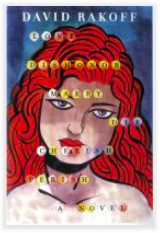
Love, Dishonor, Marry, Die, Cherish, Perish: A Novel by David Rakoff | Review

Rakoff, David_Love, Dishonor, Marry, Die, Cherish, Perish_ A Novel

Publication: New York : Doubleday, 2013

Genre: Humanity Fiction, Fiction in Verse

Pages: 113, with color illustrations

Formats: Paperback, Audiobook, eBook

Source: MCL

David Rakoff envelopes the heart of sadness with this Dr. Seussian novel. I’m terming Rakoff’s book after the author of Oh, the Places You’ll Go! because, in it, Rakoff has an almost religious devotion to timing his characters’ tales along traditional rhyming schemes. And it’s the lulling sound of this book’s prose that creates a sense of security in which Rakoff can then bring his readers face to face with some of the most profound horrors of human experiences.

To be more specific, even at the risk of having my last statement judged as overly dramatic, the opening character-story of the novel involves a violent domestic rape for which the preteen victim is then blamed and thrown out of the house by her mother. Using such an example of humanity’s underbelly and misappropriated morals to set the stage, the novel’s very blue hue contrasts with the bright blush of its often devastating narrative twists. Because of its unabashed approach in connecting readers on a very visceral level with the lives of its twelve main characters as they march through the twentieth century, I highly recommend this book to anyone trying to understand the humanity behind how the United States has come to its current state of affairs and what that means for its individuals.

To be sure, Rakoff certainly doesn’t apologize for shocking his audience awake. In our current political and cultural climate, utilizing shock value might be more advisable than in periods of actual genteel rest (what peaceful periods of gentility those would be, in particular, can probably be explained by someone of a more hopeful resolve than I could ever dream of possessing).

If you listen to the audio version of this book, please be prepared for another layer of heartbreak. For while the story itself danced so gracefully through the darkest parts of our cultural history (and ongoing realities), my throat constricted at the sound of Rakoff’s cancer taking over his rasping voice as he struggles (and more so in the later chapters) through each set of rhyming couplets. We lost Rakoff in 2012, and the world is poorer without him. For more on his graceful, yet not without justified frustration and sadness, battle with cancer: https://m.youtube.com/watch?v=ldqjM7x6NhE.

In memoriam: How is it, both this novel and the loss of its writer cry, that the important pieces of society should pass us by with such subtle depths of lasting calmness while we blink in unending thoughtlessness?

hiding from the masses | 2018.09.01

This Star Shall Abide by Sylvia Louise Engdahl | Review

Engdahl, Sylvia Louise_This Star Shall Abide

Publication: New York, Atheneum, 1972

Genre: Science Fiction, Young Adult Fiction

Pages: 247

Formats: Paperback, Hardcover

Source: Sylvia Engdahl’s Site

This book proved quite a rollercoaster for the emotions. Having given it my first read as an adult, I found myself wishing I’d come across it in my youth. This book is geared toward a YA audience, to be sure, but I feel the foundational concepts it explores would also do most adults some tremendous good. The plot is centered around questioning the nature of societal rules and traditional beliefs.

Engdahl does a very convincing job of pulling the reader along with her main character’s struggles (hence the emotional joy, and sometimes disparaging, ride) as he tries to stay true to his mission of . . . well, pursuing truth. Noren isn’t fooled for a minute during the first half of the book by the traditions he’s been spoon fed from birth. When he’s forced to accept these same ideals, albeit for reasons he’d never before suspected, near the end, I found my stomach churning with his at the dire proposition that humanity in its majority can’t often handle reality. Most of us need our comforts while those brave enough (or simply curious enough) to face the truth are left to deal with the consequences.

I remember years ago a mentor, in response to my endless stream of philosophical quandaries, warning me, “Most people don’t care that much.” In the over-hopefulness of youth, I disregarded her cautioning, but Engdahl seems to have been on the same page. I like how Jo Walton put it in her comments about this book, that even though some of the premises might stand on a precarious knife’s edge, “it’s a book that does encourage that most essential element of science fiction: thinking about it.”

While racing through This Star Shall Abide, I simultaneously consumed Cixin Liu’s The Three Body Problem. I can’t help but be amazed at the parallels between these two books with regard to protecting the masses through veiled explanations of scientific discovery and the power of religious feelings that often overtake new discoveries. When themes keep popping up in literature, those are probably the ones to stop and consider.

I still wish the world didn’t carry so much evidence in favor of the assertion, as proclaimed by both Engdahl and my mentor, that the masses don’t give a shit about reality or about the possibility of understanding truth (even if that truth is predicated on  relativistic perspectives). As exemplified in Hitchcock’s Rope, people who don’t want to dig deeper on the philosophical plane certainly aren’t of less value. If the world were made up entirely of theoretical philosophers, the homeless and those overwhelmed with addiction or mental illness probably wouldn’t stand a chance.

Certainly this book inspires all types (Villagers, Technicians, and Scholars alike) to at least think about it, even a little. This is the beauty of books, as they enable a window of influence to seep into our subconscious, if we’re willing to at least take the time to engage. Caveats, always caveats.

grieving the last page | 2018.10.23

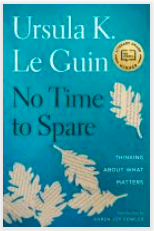
No Time to Spare: Thinking About What Matters by Ursula K. Le Guin | Review

Le Guin, Ursula K_No Time to Spare

Publication: Boston : Houghton Mifflin Harcourt, 2017

Genre: Essays, Selections

Pages: 215 | Audio Length: 6 hours, 33 minutes

Formats: Paperback, Hardcover

Source: MCL

There are some books that I find do not lend themselves to binge reading. Instead, they demand a more carefully plotted pace, with long rests in between so that a reader might catch her breath and reflect.

I purchased Le Guin’s No Time to Spare on Audible some time this spring and just finished it last Tuesday. The irony of the title versus my drawn-out consumption of its contents is now giving me pause. My finishing was not without a regretful sigh, as if the last syllables of the text were punctuating a farewell from a dear friend. Sure, this feeling was probably heightened by Le Guin’s passing this year, but I find this experience of loss at the turning of the last pages of a book has more to do with a particularly perfect coupling of the essence of what was said in the text itself and the reader’s state of mind when she approached that specific piece of writing.

For myself and this book, I think it was the cats. My cat gave up on this world in May this year, and my trips to the vet with her on the number 20 bus up into the West Hills above Portland during a very long, dreary weekend were accompanied by Le Guin’s essays about her many feline companions, the sorrows of losing them, and the curious joys of getting to know the next. While I tried to sooth my cat in the final days of her nearly twenty-something years, Le Guin whispered distractions of insights about what it must mean to write “the great American novel” and how The Grapes of Wrath will always be her favourite in that category. Her comments about answering fan letters from children, as well as how she never liked the grammatically nonsensical phrase about not being able to have your cake and eat it too, were a welcome reprieve from my perch on the curb outside the vet’s office while I waited for the tests that I knew would show Nadia had already reached a state of incurability.

After that difficult month, I got sidetracked by other books and projects. My partner and I filled our weekends with camping to stay away from an apartment now devoid of its most (between the three of us, anyways) pleasant presence. Then a couple months ago, I realized I had been stealing snatches of time between all these other activities to tune into Le Guin’s No Time to Spare, but usually only in moments of distress. I realized this book had become like some sacred text that steadied my nerves and calmed my whirling thoughts to a more predictable rhythm each time I picked it up. And, again, I think it’s both because of the state of my mind in this phase of my life along with the poignance of her essay topics.

As my curiously reverent attitude towards the book dawned on me, I found my favorite pieces were her essays about anger in the relation to feminism and politics, along with the one in which she explains how belief really has absolutely no place in the argument between science and religion. In taking one’s time with a piece of literature such as this (the irony of the title against this recommendation for a slower reading aside), I think the reader gains a greater ability to connect with the writing, its author, and the thoughts behind them both. Some books are for sipping rather than gulping, it seems, but they are usually the ones that will stay with a reader the longest.

the true naming convention | 2018.04.07

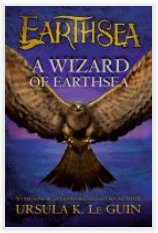
A Wizard of Earthsea by Ursula K. Le Guin | Review

Le Guin, Ursula K_A Wizard of Earthsea

Publication: 1968 (Parnassus Press)

Genre: Fantasy, Young Adult Fiction

Pages: 205

Formats: Paperback, Hardcover

Source: MCL

So, what the hell’s in a name, anyways? (Sorry, Ursula, if you’re still listening from some celestial plane, I know curse words seem tired exclamation points for you. May the irony not be lost.) But what are we trying to say when we talk about the importance of language if we are not speaking of a devotion to relate the true essence of our surroundings and our co-inhabitants in some fashion or another?

“To summon a thing that is not there at all, to call it by speaking its true name, that is a great mastery, not lightly used,” for “then you may learn its true name, knowing its being.”

Those of you who know this book inside and out are no doubt all too keenly aware those quotes are taken a bit out of context. But, honestly, what is this book if not a searching for identity? Before there was the epic of Star Wars or the thrill of Hogwarts, there was the Wizard of Earthsea. And may he live forever in our culture as the trend-setter of “he who shall not be named.” Ged’s journey (breaking all the true names rules there) is one we’ll forever recognize. For while this is an expertly illustrated coming of age tale, Le Guin seems to want her however young or older readers to stop and consider the true nature of what it means to find oneself. Being true to yourself is never easy, especially in the face of our many cultural expectations.

I wasn’t exactly sure what to expect with this book, after having surged headlong through The Lathe of Heaven, The Dispossessed, and The Left Hand of Darkness. Early into the book, however, I noted the Harry Potter similarities poking through with eery starkness. One of my dearest hopes in this life is to learn the art of calling others to account without anger or complete degradation. In her blog post “Art, Information, Theft, and Confusion,” Le Guin quite diplomatically calls out the creator of the Harry Potter series as she discusses her preference for “writers who…have enough sense of their own worth to appreciate their predecessors and fellow-writers in the salt mines of literature.” But this is not a diatribe against an author who let her critics praise her supposed invention of an already well-established genre so much so that she promised to bring copyright lawsuits down on the heads of her fan-fiction writers.

My hometown recently showed the wonderful filmmaker Arwen Curry’s documentary “Worlds of Ursula K. Le Guin,” and I caught my breath at Le Guin’s laughing admittance that she wrote A Wizard of Earthsea as a nod to the power of words themselves. For fantasy readers, magic has always been assumed to be buried in the depths of the most carefully chosen words, as well as in the true names for things, for “he who would be Seamaster must know the true name of every drop of water in the sea.”

This maxim brings to mind William Stafford’s poem “A Ritual to Read Each Other” in its “appeal to a voice, to something shadowy, a remote important region in all who talk: though we could fool each other, we should consider–lest the parade of our mutual life get lost in the dark. For it is important that awake people be awake, or a breaking line may discourage them back to sleep; the signals we give–yes or no, or maybe–should be clear: the darkness around us is deep.”

And therein lies the true magic of Le Guin’s novel. For while it is advertised as a classic YA book of high fantasy, the deeper lessons it offers regarding the might of our words, the identities they give us, and our understanding of the world within our often-times all too rigid cultures are such crucial reminders of cautious stewardship not just for the youths of our society.

presumptions of innocence | 2018.04.24

Missoula: Rape and the Justice System in a College Town by Jon Krakauer | Review

Krakauer, Jon_Missoula

Publication: New York : Doubleday, [2015]

Genre: Investigative Journalism, Nonfiction

Pages: 367

Formats: Paperback, Hardcover

Source: MCL

I’ve been avoiding this review for personal reasons but now feel some comment must be made in the wake of last week’s Supreme Court Justice confirmation.

This book details the rape and sexual assault crisis at the University of Montana from 2008 to 2012 and details the repeated failings of the justice system in its inability to appropriately respond. Krakauer’s research, alongside his own investigative journalism, gives this book a measured voice. It certainly hits the nerve needed to pull our country out from its hiding place behind white male rage so we can try and have a more productive discussion about sexual abuse.

The same friend who recommended Anu Partanen’s book, The Nordic Theory of Everything, to me also recommended Krakauer’s. While my friend’s encouragement for me to read Partanen’s book was based on her own feelings of frustration about the United States’ current political and economic situation, her holiday gift to me last December of Missoula: Rape and the Justice System in a College Town felt more like a gesture of understanding and attempted solidarity.

When non-victims of sexual abuse (and mind you, the national statistics show victims of contact sexual abuse are as high as one out of three women, and that one in four girls and one in six boys are sexually abused before their 18th birthday) practice compassion by offering up tools for possible real understanding, they give room for those of us who are victims to have an impactful voice. And, please note, the type of understanding I’m talking about is not the kind that non-victims tote around in a prayer bag of self-aggrandized ideas of healing and reconciliation. I’m cheering for those non-victims who have the humility to actually clear their minds and listen to those of us who have survived sexual abuse in one form or another.

(Disclaimer: I am extremely lucky in that I have not experienced rape. However, a male authority figure in my family did sexually abuse me on repeated occasions beginning when I was about eight or nine years old. That’s all I’m going to say on that subject at this time, as there are better mediums where these details can be brought into the focus that I may utilize someday. I’m happy to talk with anyone about the details offline if you’d like to message me on Twitter @agathaagnusblac.)

The number one takeaway from the Kavanaugh-sexual-assault debate has been that Dr. Christine Blasey Ford’s testimony (as well as those of Deborah Ramirez and Julie Swetnick) could not be proven true and therefore, according to the tone from the right-leaning media and Kavanaugh himself, all accusations of sexual abuse should be deemed as ploys by one political party to destroy American values. But this entirely misses the point. Specifically, this type of thought process is an infuriating example of misused inductive reasoning, in that it allows one specific observation to inform a broader conclusion, such as “Sally’s grandfather is bald, therefore all grandfathers are bald.” We need to remember that Ford’s accusations were also not disproven, and that the mantra of the U.S. justice system that trumpets the presumption of innocence needs to apply to the accuser also.

Certainly, the highly aggressive, victim-stance that Kavanaugh took on when questioned about his possible past misconducts should not put confidence in the minds of the undecided about his case. Yes, being accused does not equate to being guilty, absolutely. But when/if someone is falsely accused, one would hope they would have the decency to remember the larger conversation and to handle such grave accusations with more maturity than to shout such a childish threat like “what goes around, comes around.”

And what is that larger conversation? Coming back to Krakauer’s book, which gives some very soberingly explicit examples of sexual assault, that larger conversation is about how our nation’s culture does not seem to understand sexual abuse, how to talk about it, or how to respect those who have been its victims. We are so scared to falsely punish those accused of sexual crimes that our knee-jerk reaction has instead been to criminalize the victims. On the last page of his book, Krakauer states that “rapists [and other types of sex offenders] rely on the silence of their victims to elude accountability.” By allowing the silence to continue, we have let gross and damaging acts of sexual aggression become the norm. Krakauer’s narrative and the recent conservative responses to actions like the #MeToo Movement or the Kavanaugh hearings showcase that our society has lost all moral perspective on this issue (if we had any to begin with).

Remembering my initial reaction to Krakauer’s book earlier this year and then watching the Kavanaugh debate this last month has reminded me of how quick our justice system is to do nothing, or at least as little as possible, in the name of “the presumption of innocence.”